What determines catch basin cost?
Catch basin costs $1,200–$2,800 each, as of Oct 2026 nationally for the published package scope. Quantity, access, surface and the outlet move the price.
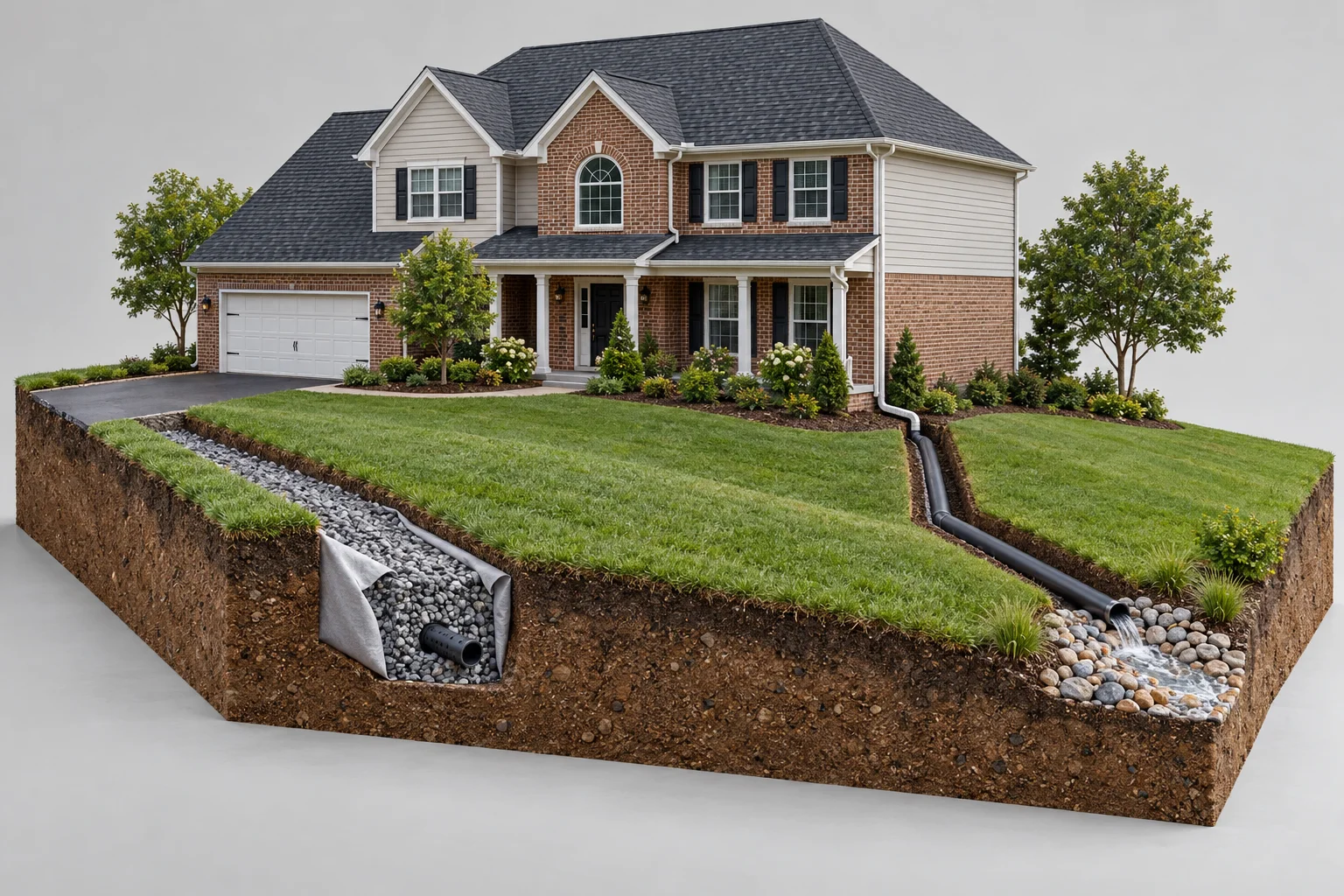
- Collect the waterA trench lined with filter fabric holds clean gravel and a perforated pipe. Water in soggy soil seeps into the gravel and pipe.
- Keep roof water separateDownspout water runs in its own solid pipe so it doesn't overload the drain.
- Let it out at lower groundThe pipe slopes to an outlet, here a pop-up emitter. A pro checks that the outlet can take the water.
Read the basin package before adding pipe
Catch basin cost is a package rate with pipe and a simple outfall in the source scope. That distinction prevents double counting. A quote may reasonably include extra pipe outside the package, but it should say where the included run ends and why more work is needed.
Do not add a complete package and then independently charge for the same included run in your planning budget. Ask each bidder to mark the basin, connecting line and outfall so that price differences can be compared against the actual layout rather than just the name of the product.
Count collection points with their connections
The quantity examples count basin packages. They do not establish how many collection points your yard needs or whether separate basins can share a pipe. A site assessment should explain where surface water arrives and how it reaches each grate.
Ask whether the quoted count includes junction fittings, cleaning access and the downstream route. A proposal with fewer basins may still solve the problem if the surface directs water correctly, while extra boxes without a workable outlet may add cost without addressing the wet spot. Compare the intended water path as well as the count.
Distinguish the grate from the finished surround
A basin in lawn is a different installation setting from a grate at a paved edge or vehicle area. Ask for the product and the finished surface detail in the written proposal. The planning package does not establish a loading rating or cover any possible paving repair.
If the contractor needs to reshape nearby ground so water reaches the grate, identify that work separately. A box placed in an existing depression and a complete surface correction are not identical scopes. This distinction explains price differences more usefully than assuming that every higher quote is overcharging.
Confirm what the outfall can accept
A simple outfall is only useful if its receiving location is suitable. Ask the bidder to identify any permission, connection or infiltration assessment that the proposed discharge depends on. An existing pipe should be checked before it is treated as a ready outlet.
Where the proposal calls for additional discharge work, have the scope stated clearly so it is not hidden in a vague basin allowance. The planning range cannot certify a public connection or prove that downstream ground will accept the collected runoff. Resolve those questions before agreeing to the excavation.
Include sediment access and surface repair
Ask how the grate can be opened, how collected sediment will be removed and what access remains after landscaping. A cheaper product or hidden junction may change maintenance access even if the headline installed price is lower. Keep product details and a route record at handover.
Surface repair also needs a clear description: backfill, finished lawn and paving reinstatement are different outcomes. The example excludes selected lawn restoration and unlisted work, so use it to question the scope rather than treating its total as a complete quote for an unseen property.
Prices by quantity
Catch basin costs $1,200–$2,800 each, as of Oct 2026 nationally for the published package scope. Quantity, ground, access and the outlet move the price.
The range above is based on published rates, not a measured local average. Check what is included before comparing a contractor's proposal.
| Quantity | Range | Typical* |
|---|---|---|
| 1 assembly / package | $1,200–$2,800 | $2,000 |
| 2 assembly / packages | $2,400–$5,600 | $4,000 |
*Typical is the midpoint of the published low and high rate. Ranges by length include ±15% for the measured length. Examples use open lawn access, known flat terrain and high confidence, with no new outlet or lawn restoration.
Local labor is unadjusted. Quantities illustrate the model; they are not design recommendations.
A worked planning example
For 2 assembly / packages on that same basis, the example comes to low $2,400, typical $4,000 and high $5,600, as of Oct 2026.
- Catch basin with pipe and simple outfall — $2,400–$5,600, typical $4,000
New outlet: – (excluded). Lawn restoration: – (excluded). Those exclusions do not mean that either item is free.
Confirm an existing outlet before relying on this basis; the example does not establish that your property has one.
What the price covers
In the price
- Catch basin with pipe and simple outfall
- Work described by the published package scope
Added or excluded
- New outlet and lawn restoration unless selected
- Permits, engineering, utility relocation and structural repair
One basin package includes 30–50 linear ft of pipe and simple outfall; do not add the same run twice.
One basin package includes 30–50 linear ft of pipe and simple outfall; do not add the same run twice. The worked example isolates the selected job so you can compare the underlying scope. A different outlet, a disturbed lawn or difficult access can change the project.
Ask which parts of a proposed price are already included in the package before adding a separate allowance. Keep a marked route or work boundary with the quote so a later change can be priced against the same starting point.
The calculator adjusts for surface and access. A lawn route with open access is a different basis from work through paving or an area that must be dug by hand. Tell each bidder about narrow gates, steps, planting and surfaces that must remain.
An aerial image cannot confirm buried utilities, soil conditions or the condition of an existing outlet. Checking terrain on the map does not update the price; confirm the ground conditions in the calculator.
Permits, engineering, utility relocation, structural repair, taxes and unlisted work are excluded from these planning examples. Ask for those items explicitly if the job needs them. Imported fill, topsoil and sod are also outside the yard-regrading base rate.
A contractor's written scope should explain the finish, cleanup and any work left for you after the drainage installation. Missing items are a reason to ask a question, rather than a reason to assume that the lowest total is complete.
How should I compare written quotes?
Give each bidder the same job description, quantity and intended discharge arrangement. Ask for a breakdown that distinguishes the collection work, pipe route, outlet and surface repair. When a quote differs from the planning range, ask which site condition or scope item explains the difference.
The calculator is a reference for that conversation; it cannot establish a contractor's labor rate or guarantee a final price.
Check whether a package already includes the pipe or outfall being listed elsewhere in the proposal. A lower price may omit restoration or rely on an existing connection that has not been inspected. A higher price may include extra work that you actually need.
Compare those differences before negotiating the total. Have changes to the route, materials or finish written into the agreement so the accepted scope remains clear.
Ask when payments are due, who handles any required permission and how concealed conditions will be discussed before extra work proceeds. Keep product details and a record of the installed route at handover. This site currently relies only on a written agreement and service to your ZIP when identifying a contractor; it does not promise unverified licence or insurance checks.
Catch basin: installation and upkeep
Sources
- Ledge — catch basin estimating, checked 2026-10-26. One basin with 30–50 linear ft of pipe and simple outfall
- HomeGuide — drainage system installation cost, published 2026-02-06, checked 2026-10-26
- Richmond Retaining Wall Company — grading planning rates, checked 2026-10-26. Published planning rates, topsoil and vegetation separate